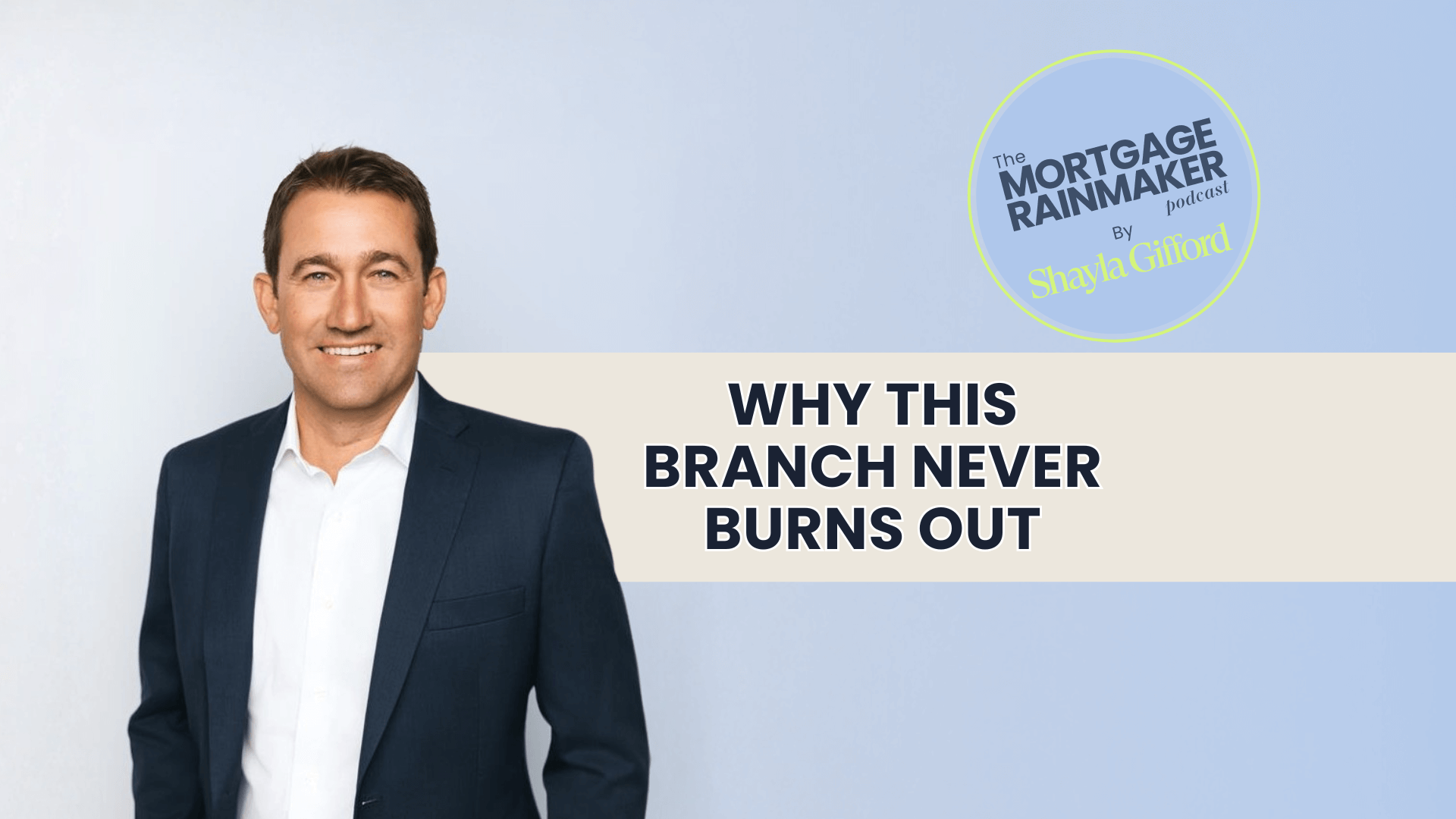
What if joy wasn’t just a feeling, but one of the most effective mortgage branch management strategies available?
For most branch managers, growth comes with a tradeoff: more volume, more pressure, more burnout. But Casey Oiness proves that scaling doesn’t have to cost you your culture, your energy, or your people.
Casey leads a $180–$200M producing branch with 22 loan officers and over 50 team members, and does it with rhythm, accountability, and fun baked into the business. In this episode of The Mortgage Rainmaker Podcast, we break down the exact mortgage branch management strategies he uses to scale production and build a team people actually want to be part of.
If you’re a branch leader who wants to grow without chaos, this is your blueprint.
Why Every Branch Needs Mortgage Branch Management Strategies
Talent alone doesn’t scale a branch, systems do.
Many mortgage branches rely on personalities instead of process. That works until it doesn’t. When markets tighten, rates shift, or volume fluctuates, branches without clear management strategies fall apart.
Effective mortgage branch management strategies give you:
- Predictable growth instead of random wins
- Accountability without micromanagement
- Culture that attracts producers (instead of repelling them)
- A leadership structure that doesn’t rely solely on you
Casey’s branch didn’t reach $200M by accident. It was built intentionally, with structure, cadence, and standards that scale.
4 Proven Mortgage Branch Management Strategies to Build a High-Performance Team
1. Joy as a Competitive Advantage
Most leaders treat culture as a “nice to have.” Casey treats it like a production driver.
Joy isn’t accidental in his branch, it’s designed. From weekly in-office energy to team events, competitions, and shared wins, the environment itself fuels performance.
Why this matters:
- Happy teams stay longer
- Engaged LOs prospect more consistently
- Fun removes fear, which increases activity
Burned-out branches lose talent. Energized branches attract it.
Joy isn’t fluff…it’s leverage.
2. Accountability Rhythms That Actually Work
One of the most overlooked mortgage branch management strategies is rhythm.
Casey’s branch runs on predictable accountability:
- Weekly Monday meetings to set focus and track activity
- Clear expectations around production and behavior
- Open collaboration where wins and challenges are shared
This rhythm does two things:
- It removes ambiguity
- It keeps momentum from stalling
Accountability doesn’t have to feel heavy. When it’s consistent and team-driven, it becomes empowering.
3. The Shared Support Model
One reason Casey’s loan officers scale faster is that they’re not buried in tasks that don’t require them.
His branch uses a shared support model:
- Pre-approval specialists
- Shared processors
- Backend systems that free LOs to hunt
Instead of every LO building a bloated personal team too early, the branch provides infrastructure that grows with them.
This is one of the most effective mortgage branch management strategies for:
- Preventing burnout
- Increasing consistency
- Helping mid-level LOs reach top-producer status
(If you’re thinking about how these ties into hiring for a mortgage team, this model dramatically changes who you recruit and when.)
4. Teach Your LOs to Present…Not Just “Chat”
Most loan officers don’t lose partners because they’re bad lenders. They lose them because they can’t articulate value.
Casey coaches his team to:
- Lead structured conversations
- Present solutions, not rates
- Show partners how the relationship increases revenue
Instead of coffee meetings that go nowhere, his LOs run intentional partner meetings with a clear ask and follow-up plan.
This is where mortgage branch management strategies directly impact partner conversion, not just culture.
Recruiting Secrets: How to Grow Without Cold Calling
One of the most powerful insights from Casey’s leadership is this: he doesn’t recruit by volume…he recruits by alignment.
In an industry where many branch managers are blasting LinkedIn messages, cold-calling producers, or chasing résumés based on past volume, Casey takes a completely different approach. His belief is simple: the right people attract more of the right people.
Most of his branch growth comes from three core sources:
Referrals inside the branch
When your culture is strong, your people become your recruiters. Loan officers who feel supported, challenged, and energized naturally tell their peers, “You should come see what we’re building.” That kind of referral carries more weight than any cold outreach ever could.
Reputation in the market
Casey’s branch is known for performance, professionalism, and fun. Producers who feel stuck, unsupported, or burned out elsewhere start paying attention. They don’t need to be sold, they’re already curious.
Producers bringing other producers
High performers want to work alongside other high performers. When you build an environment that pushes people to grow while protecting their quality of life, top talent self-selects in.
Casey is intentional about who he brings in. He hires people he’d “go to battle with,” not just names on a spreadsheet or volume producers who might disrupt the culture. Skill can be developed. Character, work ethic, and alignment cannot.
That philosophy reflects what strong mortgage leadership looks like today:
- Low drama: Emotional maturity is non-negotiable
- High standards: Activity, accountability, and professionalism matter
- Long-term vision: Decisions are made for sustainability, not short-term spikes
The result is a branch where nearly 50% of loan officers qualify for President’s Club, not because of pressure or fear, but because the environment makes excellence the norm.
Coaching the “Sniper” Approach to Partnerships
Another standout mortgage branch management strategy Casey uses, and coaches relentlessly, is the sniper approach to referral partnerships.
Instead of teaching loan officers to chase every agent, attend endless networking events, or juggle dozens of shallow relationships, Casey encourages his team to go deep, not wide.
The focus is clear:
- 5–10 committed referral partners
- One to two transactions per month per partner
- Deep, intentional relationship investment
This approach completely changes how loan officers show up in their business.
Rather than reacting to whoever calls next, LOs become proactive:
- They know exactly who they’re building with
- They plan value, touchpoints, and conversations in advance
- They position themselves as a true extension of the agent’s business
Because the relationship is deeper, the value is higher. Instead of generic check-ins or rate talk, conversations revolve around:
- Lead conversion
- Business planning
- Events and client experience
- Systems that help both sides win
This creates loyalty that survives market shifts, rate changes, and industry noise. When agents feel genuinely supported, not “worked”…they stay.
At the core of this philosophy is a truth Casey lives by and teaches his team: warm introductions always outperform cold calls.
His branch coaches loan officers to leverage their existing network, ask for introductions, and pursue partners they’re genuinely excited to work with. When the chase feels aligned and energizing, consistency becomes easier and results follow.
This sniper strategy doesn’t just improve production. It protects focus, confidence, and long-term momentum, which is exactly what elite mortgage professionals need to win in any market.
Are You Renting Your Mortgage Branch Management Strategies, or Owning Them?
One of the most powerful moments in the conversation was Casey’s distinction between renting your business and owning it.
Renting looks like:
- Buying leads
- Chasing shiny objects
- Relying on platforms you don’t control
Owning looks like:
- Relationships
- Past-client systems
- Partner loyalty
- Culture that retains talent
Strong mortgage branch management strategies are about ownership. They compound over time and protect you when the market shifts.
If you want help building a thriving team that lasts, this mindset shift is non-negotiable.
Final Thoughts: The Real Secret Ingredient
The secret ingredient behind Casey Oiness’ success isn’t volume, markets, or luck.
ILeadership that:
- Treats joy as a performance driver, not a perk
- Creates accountability through rhythm, not pressure
- Invests in people before expecting results
- Builds systems that scale without sacrificing culture
Casey’s branch proves that you don’t have to choose between production and fulfillment. You can build a business that wins and feels good to run — one where people stay, grow, and perform at the highest level.
If you’re a branch manager who wants to scale without burning out your team, losing your culture, or waking up dreading the business you built, this is the standard to study.
Because the future of mortgage leadership isn’t louder, harder, or faster.
It’s clearer, more intentional, and led with joy.